Traditional architecture of Casamance: the impluvium houses that defy time
There are places in the world where architecture is not just shelter, but also memory, identity and intelligent response to the environment. Casamance, the southernmost region of Senegal, hides one of those places: a set of villages where the Diola people have built for centuries two-story houses capable of collecting rainwater, resisting Atlantic winds and organizing community life around an interior courtyard. Learning about the traditional architecture of Casamance is to delve into a way of inhabiting the world that no contemporary architecture textbook could imagine.
Unlike what happens in other regions of West Africa, where traditional housing tends to be a simple single-story construction, the Diola architecture of Casamance surprises with its structural complexity and the sophistication of its technical solutions. The impluvium houses, called etampaf in the Diola language, are two-story buildings constructed with laterite, palm wood and clay, designed to capture rainwater through a central open courtyard. This solution, which vaguely recalls the Roman impluvium, was developed completely independently by Diola communities several centuries ago, making these structures a fascinating example of vernacular engineering.
Mlomp and its impluvium houses: a living heritage
The village of Mlomp, located just a few kilometers from Oussouye in the heart of Casamance, is the place where impluvium architecture reaches its fullest expression. Here, several Diola families still preserve two-story houses that have stood for more than a hundred years, some even longer. Walking through its red earth streets is like touring an open-air museum, with the difference that the houses are inhabited and life goes on normally within their walls.
The structure of these houses is so particular that it deserves a detailed description. The ground floor is organized around an uncovered interior courtyard, the impluvium proper, toward which the roofs of the upper floor slope. During the rainy season, water falls on the courtyard and is channeled toward an underground cistern that supplies the family during the dry months. This solution is neither an accident nor an improvisation: it responds to a deep understanding of the local water cycle and demonstrates that Diola builders perfectly understood the importance of managing water in a region with marked climatic seasonality.
The upper floor, accessible by carved palm wood stairs, houses the bedrooms and offers a terrace from which the surroundings can be surveyed. The laterite walls, that reddish stone characteristic of the region, provide remarkable thermal inertia: they keep the interior cool during the day and warm at night, without need for any artificial air conditioning system. It is, in every sense, sustainable architecture avant la lettre.
Enampor: the village that preserves tradition intact
If Mlomp is the place where impluvium architecture can be studied in detail, Enampor is the village where that architecture is experienced most immersively. Also located in the Oussouye department, Enampor has one of the best-preserved impluvium houses in all of Casamance, and what makes it especially unique is that it functions as accommodation for travelers, allowing you to spend the night inside a centuries-old structure and experience from within the spatial logic that animates it.
The village of Enampor is small, peaceful and removed from mass tourist routes. Its inhabitants, faithful to Diola traditions, maintain a relationship with the built space that goes far beyond mere functionality. Every element of the house has meaning: the arrangement of rooms reflects family hierarchy, the orientation of the courtyard responds to cosmological criteria, and the domestic altars found in some corners remind us that Diola architecture cannot be understood without its spiritual dimension. Visiting Enampor with a local guide is, for this reason, an experience that goes far beyond aesthetic contemplation.
Furthermore, the natural environment of Enampor adds another layer of value to the whole. The village is surrounded by palm forests and rice paddies that the Diola cultivate with equally sophisticated hydraulic techniques, based on the construction of dikes and canals to control the entry of salt water from the estuary. This relationship between architecture, agriculture and water management forms a coherent system that heritage experts have been studying for decades and that UNESCO has recognized as having exceptional value.
Materials and construction techniques: the wisdom of the environment
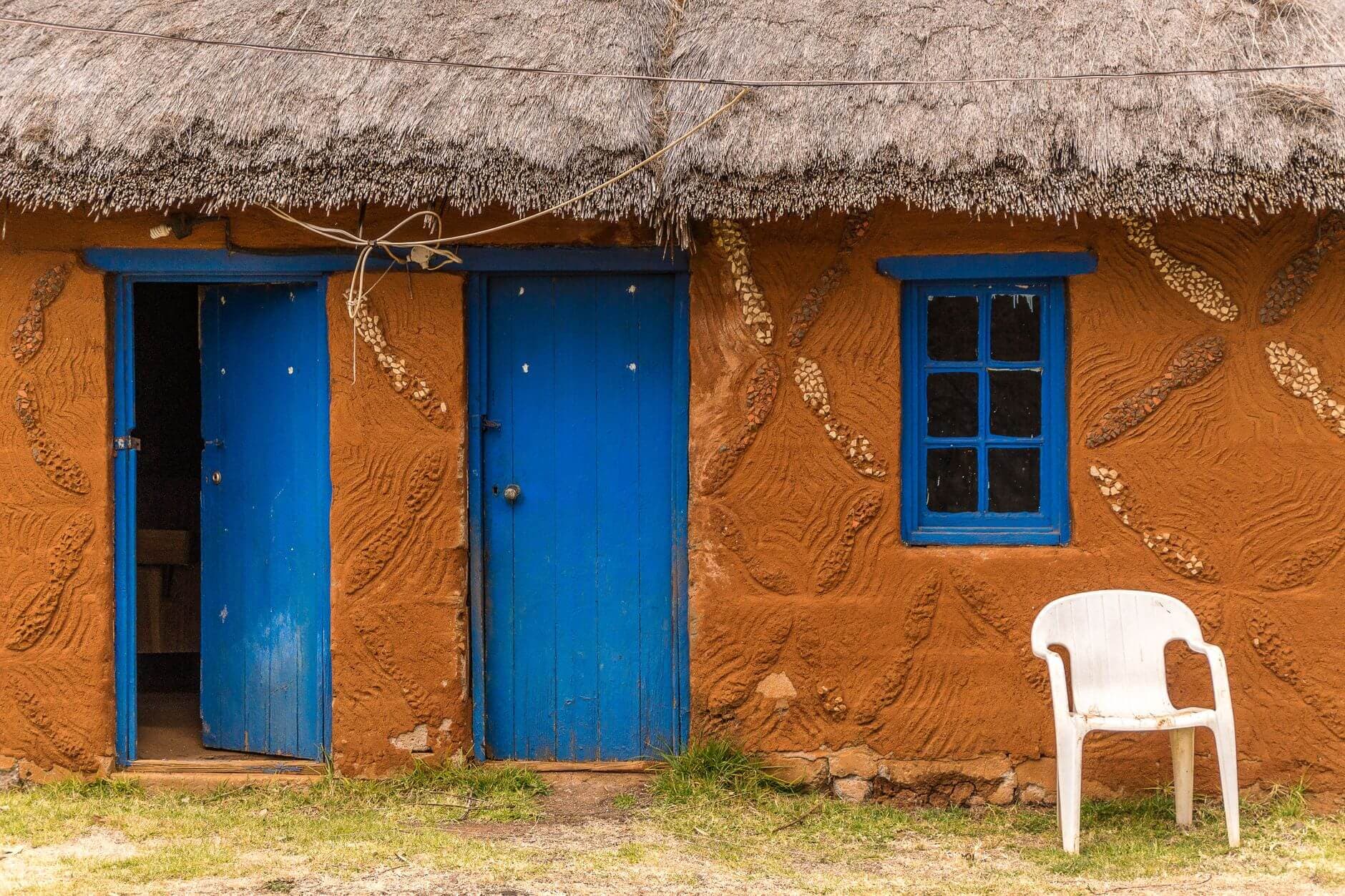
One of the most fascinating aspects of traditional architecture of Casamance is the way its builders have been able to extract from the immediate environment all the necessary materials without resorting to any external element. Laterite, which surfaces abundantly in the region's soils, is extracted in blocks and used for both walls and pavements. Palm wood, resistant and flexible, is used in beams, stairs and decorative elements. Clay, mixed with straw and crushed laterite itself, acts as mortar and finishing coating.
The process of building an impluvium house is long and collective. It is not built by a single family, but the entire community participates in the different phases, from the extraction of laterite to the raising of walls and the placement of roofs. This communal dimension of the construction process strengthens social bonds and ensures the transmission of technical knowledge from generation to generation. That is why, when one of these houses falls into disuse or collapses, more than just a building is lost: a fragment of collective memory is lost.
In recent years, some local and international organizations have worked with Diola communities to document these techniques and train young craftspeople in their practice. The goal is not to create a theme park or freeze architecture in the past, but to ensure that solutions that have worked for centuries can continue to be useful and adaptable in the future. It is, ultimately, a commitment to sustainability that stems from deep respect for local knowledge.
How to include Mlomp and Enampor in your trip to Casamance
Visiting the villages of Mlomp and Enampor is perfectly compatible with a stay in Ziguinchor, the capital of Casamance, or in the Cap Skirring area. Both villages are located in the Oussouye department and can be visited on a full-day excursion, although ideally you should reserve at least one night in the impluvium house of Enampor to experience it with the depth it deserves. Travel is usually done by four-wheel drive vehicle or by canoe through the estuary channels, which adds an additional dimension to the trip.
From NeoGeo DMC we organize guided excursions to these villages with local Diola guides who have in-depth knowledge of the history, culture and architecture of the region. We believe that the best way to visit Mlomp and Enampor is with someone who can contextualize what you see, explain the meaning of each space and facilitate respectful and enriching encounters with the inhabitants for both parties. If you are interested in including this visit in your itinerary through Casamance, contact us and we will design the experience together.
Want to discover Casamance with local experts? This is our fly-in tour.
Frequently asked questions about traditional architecture of Casamance
What exactly are Diola impluvium houses?
Impluvium houses are two-story constructions typical of the Diola people of Casamance, in southern Senegal. Their main characteristic is an uncovered interior courtyard toward which the roofs of the upper floor slope, so that rainwater is collected and stored in an underground cistern for use during the dry season. They are built with laterite, palm wood and clay, and can be more than a hundred years old.
Is it possible to sleep in a traditional impluvium house?
Yes. The village of Enampor has an impluvium house that functions as accommodation for travelers, allowing you to experience from within the spatial experience of these centuries-old constructions. It is a highly recommended option for those who want to go beyond superficial visits and truly understand the logic of this architecture.
What is the best time of year to visit Mlomp and Enampor?
The best time to visit Casamance in general, and these villages in particular, is the dry season, which runs approximately from November to May. During these months the climate is pleasant, the roads are passable and conditions for excursions are optimal. The rainy season, between June and October, has its own scenic charm, but some access routes can become difficult.
Do you need a guide to visit these villages?
It is not strictly mandatory, but it is highly recommended. Diola architecture is deeply linked to the culture, spirituality and social organization of the Diola people, and without a local guide many of the elements you see lose their meaning. Furthermore, visiting these places with a local intermediary ensures that the encounter with the community is respectful and beneficial for the inhabitants.
Is this architectural heritage in danger?
Yes, in part. Modernization, rural exodus and the cost of maintaining these structures pose a real threat to impluvium houses. However, several organizations are working with local communities to document construction techniques and train new craftspeople. Responsible tourism, which generates direct income for families that preserve these houses, is also an important tool for their preservation.