African Renaissance Monument: history, meaning and how to visit it in Senegal
There are images that become etched in memory long before arriving at a destination. The African Renaissance Monument is one of them. Visible from almost any point in Dakar, this colossal bronze sculpture rises 49 meters above the volcanic hills of Les Mamelles and has become the most recognizable symbol of Senegal in the world. Visiting it is not just a tourist excursion: it is an experience that invites reflection on the identity, history and future of an entire continent.
History and origin of the monument
The idea of the African Renaissance Monument was born from the vision of former Senegalese president Abdoulaye Wade, who conceived the work as a declaration of pride and sovereignty for Africa as a whole. The project was commissioned to the North Korean construction company Mansudae Overseas Projects, recognized for its large monumental sculptures, and the work lasted several years until its official inauguration in April 2010, coinciding with the fiftieth anniversary of Senegal's independence.
From the outset, the monument generated passionate debate both within and outside the country. Its detractors questioned the cost of the work in a context of urgent social needs, while its defenders argued that Africa needed a symbol of scale comparable to the great monuments of the Western world. This debate, far from diminishing the value of the place, adds layers of meaning that make the visit even more interesting for the curious traveler.
The name chosen was not accidental. The concept of "African renaissance" has been circulating for decades in intellectual and political circles across the continent as a metaphor for an Africa that rises up, that reclaims its pre-colonial history and that looks to the future with confidence. Wade took that concept and materialized it in bronze and steel, giving physical form to a collective aspiration.
Description and symbolism of the sculpture
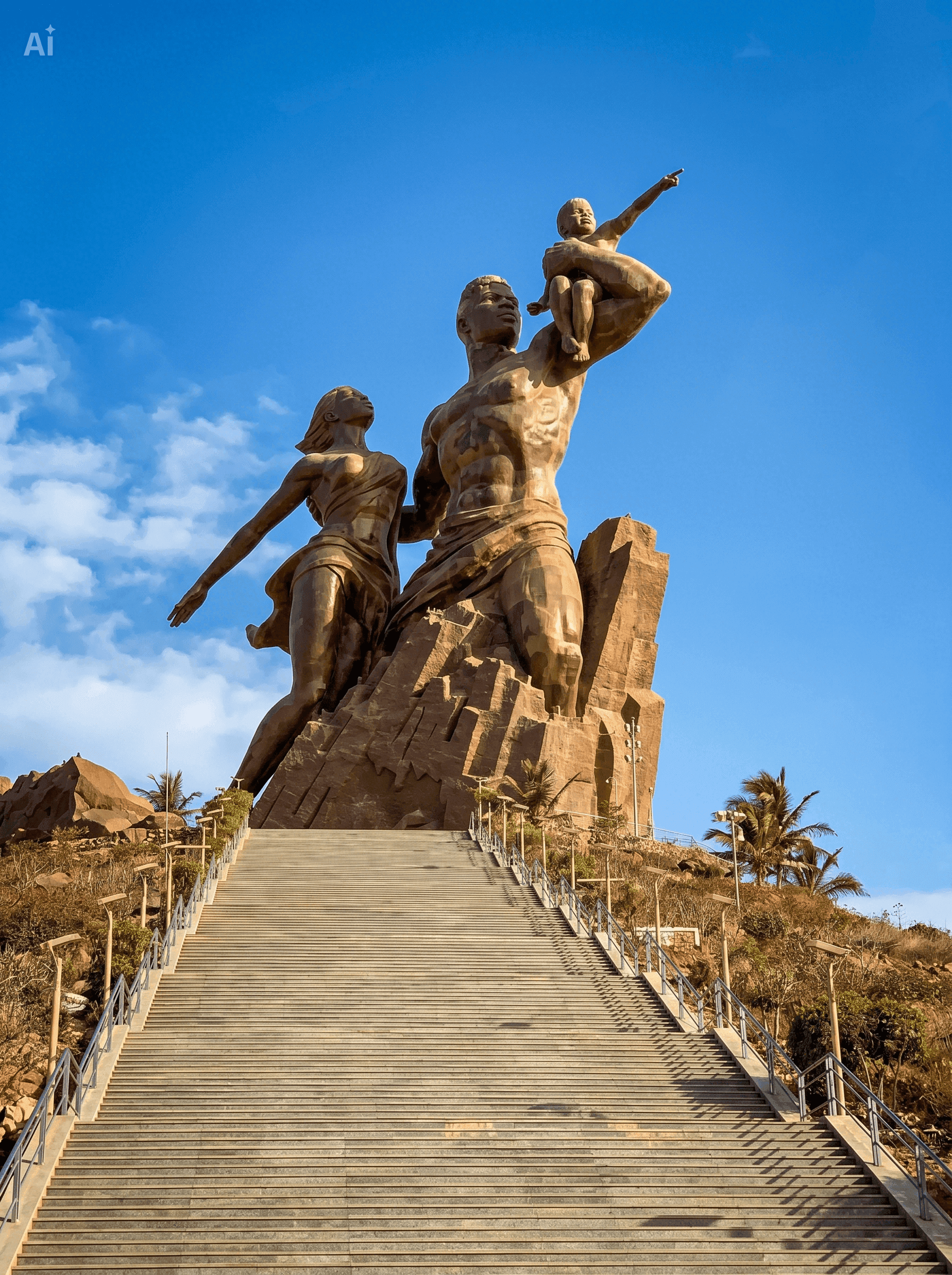
The central figure of the African Renaissance Monument Senegal represents a muscular man emerging from a volcanic mountain holding a woman with his arm extended toward the sky. She, in turn, carries a child on her shoulder who points toward the horizon with his index finger. The complete composition forms a family moving forward, leaving behind—according to the official interpretation—centuries of slavery, colonialism and subjugation.
Every element of the sculpture is laden with symbolic intention. The mountain from which the figure emerges evokes the deep roots of the African continent, while the upright posture and forward gaze convey determination and hope. The child pointing to the horizon represents future generations, heirs to a free Africa proud of itself. At 49 meters tall, it surpasses the Statue of Liberty in New York in size—if measured only the figure, without the pedestal—a detail that its promoters frequently highlight.
The materials were also subject to debate: the bronze and copper used come from various African countries, which reinforces the pan-Africanist narrative of the work. That is why, although the monument is physically located in Senegal, its creators have always presented it as a gift from Senegal to all of Africa, not as an exclusively national symbol.
How to visit the African Renaissance Monument
The monument is located in the Les Mamelles neighborhood, west of Dakar, on one of the two volcanic hills that give the area its name. Getting there from the city center is relatively straightforward: taxis and rental vehicles with drivers cover the journey in between 15 and 30 minutes depending on traffic, which in Dakar can be considerable during rush hours. From NeoGeo DMC we organize transfers and guided excursions that include the monument within a broader tour of the main monuments of Senegal, which allows you to make better use of your time and benefit from historical context during the visit.
Access to the interior of the sculpture is possible: an elevator and stairs lead up to the head of the figure, from where you can enjoy a 360-degree panorama of Dakar, the Atlantic Ocean and, on clear days, the island of Gorée. This view alone justifies the effort of climbing up. It is recommended to arrive early in the morning or at sunset, both to avoid the midday heat and to take advantage of the golden light that bathes the sculpture at those hours.
At the base of the monument there is a museum that offers information about the history of the work, its construction and the concept of African renaissance. Although the exhibitions are not always completely up to date, the space is worth visiting for those who want to delve deeper into the cultural context before or after climbing the sculpture. It is advisable to check opening hours in advance, as they may vary depending on the season and local holidays.
The monument in the context of Senegal's monuments
Senegal is an extraordinarily rich country in historical and cultural heritage, and the African Renaissance Monument occupies a prominent place within that mosaic. However, to understand it well, it is worth placing it alongside other monuments of Senegal that also deserve a visit. The island of Gorée, declared a UNESCO World Heritage Site, is perhaps the most emotionally powerful place in the country: its ancient slave houses and its silence laden with history form a perfect counterpoint to the optimism that radiates from the African Renaissance.
The Great Mosque of Touba, a holy city of Mouridism, is another architectural and spiritual landmark of the first order, although access is restricted to non-Muslims. The Pink Lake of Retba, with its pink-colored waters caused by a halophilic algae, represents the natural and surprising face of the country. And the Saloum Delta, a UNESCO Biosphere Reserve, adds a unique ecological dimension. Combining all these points in a well-designed itinerary is precisely what we do at NeoGeo DMC: create experiences that connect the great icons with lesser-known corners.
In that sense, the African Renaissance Monument functions as a symbolic gateway to Senegal. Many travelers visit it on their first day in the country, almost as a welcoming ritual, and then better understand the pride and energy that permeate Senegalese culture throughout the entire trip.
Practical tips for your visit
Comfortable clothing and appropriate footwear are essential, especially if you plan to climb to the top of the sculpture. The sun in Dakar can be intense for much of the year, so sunscreen, a hat and plenty of water are inseparable companions. Although the Les Mamelles neighborhood is safe and well-frequented by tourists, it is recommended not to carry unnecessary valuables and to hire the services of a local guide or trusted agency to avoid the more persistent street vendors who usually gather in the surrounding areas.
Photography is one of the great attractions of the visit. The sculpture offers spectacular angles from multiple points: from the base, where the perspective makes it seem even more imposing; from the top, with the ocean in the background; and from the access road, where you can capture the entire figure silhouetted against the sky. At sunset, the orange light on the bronze creates especially memorable compositions.
If traveling with family, it is worth knowing that the climb can be somewhat long for small children, although the elevator makes the ascent much easier. The experience of seeing Dakar from above usually thrills travelers of all ages, and the story of the sculpture—told in an engaging way by a good guide—can become a lesson in African history that no textbook can match.
FAQ: Frequently asked questions about the African Renaissance Monument
How tall is the African Renaissance Monument exactly?
The sculpture measures 49 meters in height, making it one of the tallest statues in the world. If you add the volcanic hill on which it stands, the figure rises more than 100 meters above sea level, making it visible from much of the city of Dakar and from the Atlantic Ocean.
Can you go inside the sculpture?
Yes, the monument has an elevator and internal stairs that allow you to climb to the head of the figure. From there you can enjoy a 360-degree panorama of Dakar, the ocean and, in good visibility conditions, the island of Gorée. Entry to the interior has an additional cost compared to access to the external gardens.
What is the best time of day to visit the monument?
Early morning and sunset are the most recommended times. The light is softer and more photogenic, the heat is less intense and visitor numbers are usually lower than at midday. Sunset, in particular, offers spectacular views of the Atlantic Ocean from the top of the sculpture.
How do you get to the African Renaissance Monument from downtown Dakar?
The most convenient way is by taxi or with a private vehicle hired through a local travel agency. The journey from downtown Dakar takes between 15 and 30 minutes depending on traffic. From NeoGeo DMC we offer guided excursions that combine a visit to the monument with other points of interest in the city, optimizing time and enriching the experience with cultural context.
What other monuments in Senegal are worth visiting along with the African Renaissance?
Senegal offers very varied heritage. The island of Gorée, with its history linked to the slave trade, is an almost mandatory visit and emotionally complements the message of the African Renaissance. The Great Mosque of Touba, the Saloum Delta and the Pink Lake of Retba are other destinations that allow you to discover the multiple dimensions—spiritual, natural and cultural—of this fascinating country.